


AI Development Platform: Cloud vs On Premise Explained
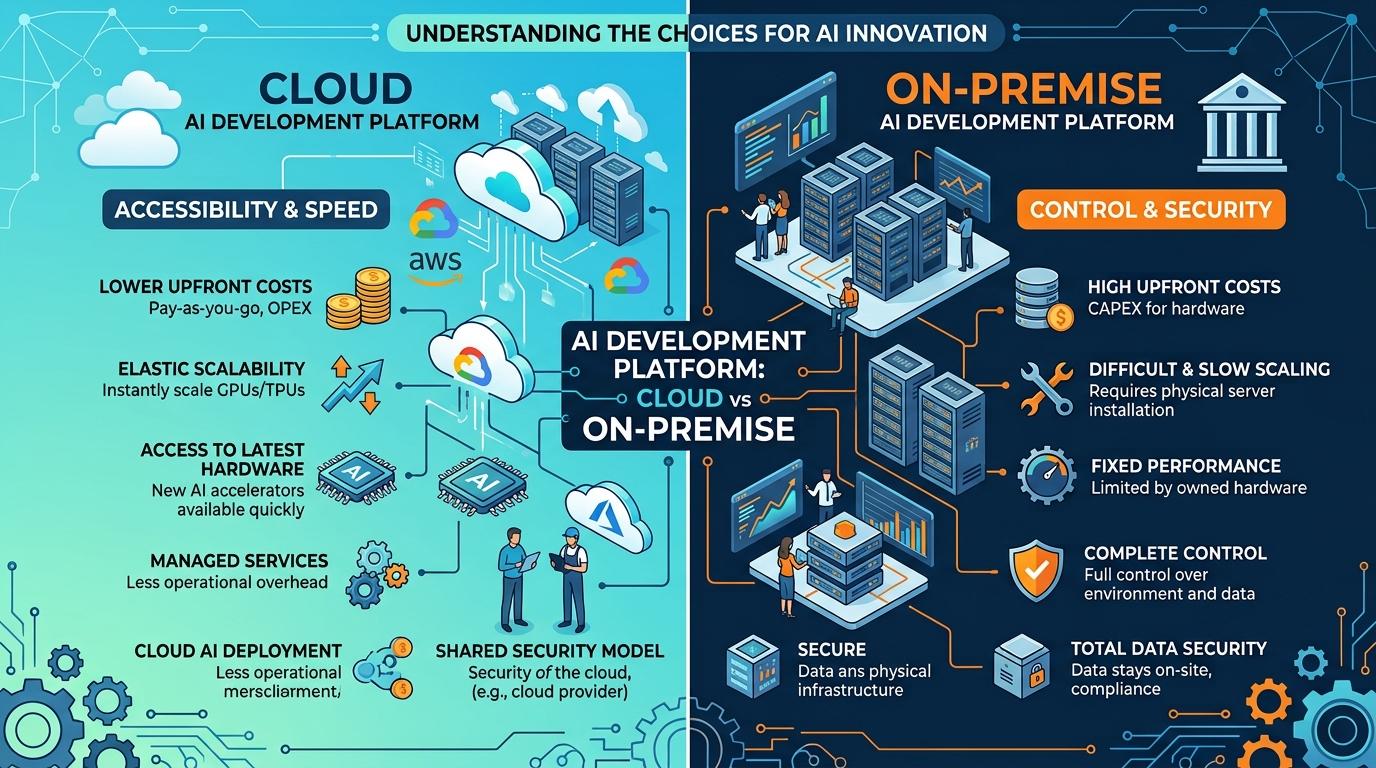
One of the earliest and most consequential decisions teams face when adopting an AI development platform is whether to deploy it through a cloud based service or run it on infrastructure the organization controls directly, commonly called on premise deployment. This decision affects cost structure, operational control, compliance posture and long term flexibility in ways that are easy to underestimate at the outset. This guide compares both approaches honestly and helps clarify which genuinely fits different organizational situations.
How Cloud Based Deployment Works
Cloud based deployment of an AI development platform means the underlying infrastructure, whether compute resources for training models, storage for data, or the serving infrastructure for deployed models, runs on a cloud provider's infrastructure rather than hardware the organization owns and manages directly. This approach has become the default choice for many teams, particularly smaller organizations or those without substantial dedicated infrastructure engineering resources, since it removes the burden of physically provisioning, maintaining and scaling hardware.
How On Premise Deployment Works
On premise deployment, by contrast, means running the AI development platform on infrastructure the organization directly owns and controls, whether in a company owned data center or in a colocation facility where the organization still manages the actual hardware. This approach demands considerably more internal infrastructure expertise and ongoing operational investment, but it offers a degree of direct control over the underlying environment that cloud deployment, by its very nature, cannot fully replicate.
Cost Comparison: More Complex Than It First Appears
Cloud deployment typically requires lower upfront investment, since there is no need to purchase and provision physical hardware before beginning work, making it particularly attractive for smaller teams or early stage projects where minimizing initial capital investment matters significantly. However, at sufficient scale and sustained usage volume, cloud costs can eventually exceed what equivalent on premise infrastructure would have cost over the same period, since cloud providers necessarily build their own margin and operational costs into their pricing.
The genuine cost comparison between cloud and on premise AI development platform deployment depends heavily on usage patterns, particularly whether workloads are steady and predictable, which favors on premise cost efficiency at scale, or variable and unpredictable, which favors the flexibility cloud infrastructure provides without paying for capacity that sits idle during quieter periods.
Control and Customization Differences
On premise deployment offers organizations direct control over every aspect of the underlying infrastructure, allowing for customization that cloud environments, constrained by what a specific provider's platform supports, cannot always accommodate. This matters particularly for organizations with genuinely unusual technical requirements or specific performance characteristics that standard cloud offerings do not naturally support well. Cloud deployment, while generally offering less granular control, provides considerable convenience and removes the burden of managing this complexity directly, which suits the significant majority of organizations without genuinely unusual infrastructure requirements.
Compliance and Data Sovereignty Considerations
For organizations operating under strict regulatory requirements, particularly around data residency and sovereignty, on premise deployment of an AI development platform sometimes becomes less a preference and more a genuine requirement, since certain regulations mandate that specific categories of data never leave organization controlled infrastructure or specific geographic boundaries. Cloud providers have increasingly addressed these concerns through region specific deployment options and compliance certifications, narrowing this gap considerably compared to several years ago, but organizations in heavily regulated industries should verify specific compliance requirements carefully before assuming either deployment model automatically satisfies their particular obligations.
Scalability Differences Worth Understanding
Cloud deployment offers a genuine advantage in scalability flexibility, allowing an organization to rapidly increase or decrease resource usage in response to actual demand without the lead time required to procure and provision additional physical hardware. On premise deployment requires more careful upfront capacity planning, since scaling beyond originally provisioned hardware capacity takes considerably longer than adjusting cloud resource allocation, making on premise deployment better suited to workloads with predictable, relatively stable resource needs rather than highly variable demand.
Security Considerations Across Both Models
Both deployment models can be configured securely, but the nature of security responsibility differs meaningfully between them. Cloud providers generally handle significant portions of underlying infrastructure security, though the organization remains responsible for properly configuring access controls and data handling within that infrastructure. On premise deployment places full security responsibility, from physical hardware security through to application level access control, directly on the organization's own team, which demands genuine security expertise that not every organization possesses in house.
Hybrid Approaches Worth Considering
Rather than choosing exclusively between cloud and on premise deployment, many organizations adopt a hybrid approach for their AI development platform usage, keeping genuinely sensitive data and workloads on premise while using cloud infrastructure for less sensitive experimentation, development work, or workloads with highly variable resource demands. This hybrid model captures meaningful benefits from both approaches, though it introduces its own coordination complexity that should be planned for deliberately rather than emerging accidentally from inconsistent deployment decisions made by different teams over time.
Making the Right Choice for Your Organization
The right choice between cloud and on premise deployment for an AI development platform depends on honestly weighing several factors specific to your organization: available internal infrastructure expertise, genuine regulatory or data sovereignty requirements, the predictability versus variability of anticipated workloads, and the organization's overall risk tolerance around infrastructure control and dependency on external providers.
Final Thought
Cloud and on premise deployment of an AI development platform each offer genuine, distinct advantages rather than one being universally superior to the other. Cloud deployment typically suits organizations prioritizing flexibility, lower upfront investment and reduced operational burden, while on premise deployment suits organizations with strict compliance requirements, predictable workloads at meaningful scale, or genuine infrastructure expertise justifying the additional control it provides. Many organizations ultimately find a thoughtfully designed hybrid approach delivers the best balance for their specific, often mixed set of requirements.

 English
 French
 Deutsch
 Русский
 Greek
Greek