


One Dry Cleaning Machine, One Store: What Services Could You Build Around This Setup?
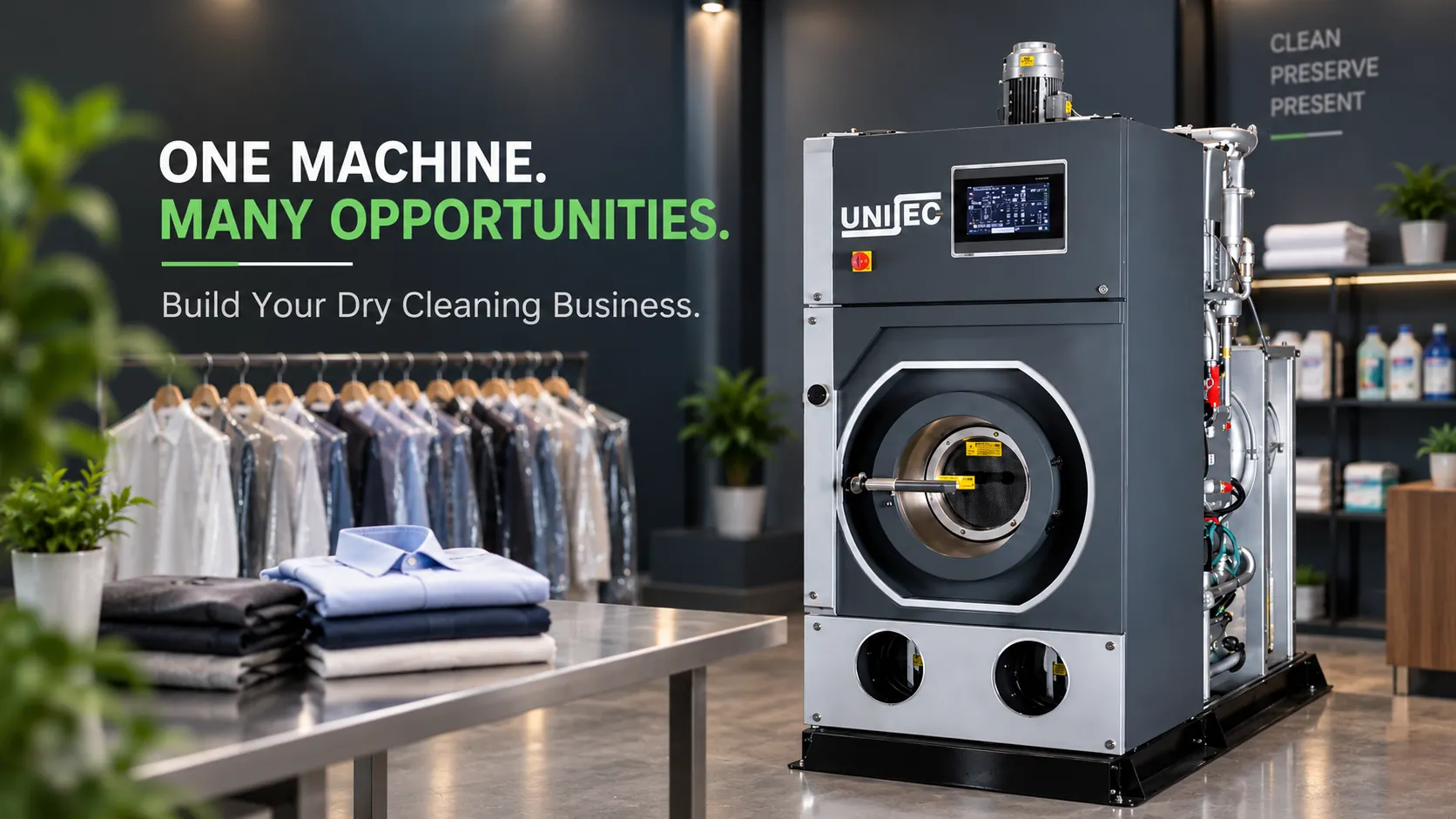
Starting a dry cleaning store does not always mean building a large facility with multiple machines from day one. For the right business model, one dry cleaning machine can become the core of a professional garment-care setup—but the real opportunity depends on what services you offer, how much volume you expect, and what supporting equipment you plan around it.
Can You Build a Dry Cleaning Business Around One Dry Cleaning Machine?
Yes, a small dry cleaning business setup can be planned around one primary machine, provided its practical capacity matches your expected workload.
However, owning one machine does not mean you have a complete dry cleaning store.
The machine performs the main cleaning process, while professional garment care involves several stages before and after cleaning:
Receiving → Inspection → Sorting → Spotting → Cleaning → Finishing → Quality Check → Packing
This distinction matters for first-time business owners. Instead of spending the entire budget on the largest professional dry cleaning machine available, think about how the whole store will operate.
A one-machine setup may make sense when:
-
You are entering the market with controlled order volume.
-
You have identified specific garment categories to target.
-
Your machine can handle the practical daily workload.
-
You have enough operating hours for the required loads.
-
Spotting and finishing processes are properly planned.
-
You want to establish demand before adding more capacity.
The business opportunity comes from building the right services around the machine—not simply installing equipment and waiting for customers.
A useful planning sequence is:
One Machine → Services → Customers → Garment Volume → Supporting Equipment → Investment → Expansion
What Services Can a Small Dry Cleaning Store Offer?
Before choosing a commercial dry cleaning machine, decide which garment-care services your store intends to provide.
A small store could potentially build its service mix around suitable garments such as suits, jackets, formal wear, occasion wear and other items requiring professional garment care. The exact cleaning process must always depend on the garment's fabric, construction, care requirements and compatibility with the selected system.
This is why every garment should not automatically follow the same process.
A better workflow begins with inspection.
Suit and formal-wear care
Office professionals and customers with formal wardrobes can create recurring demand for garment-care services. Jackets, trousers and suits should be inspected and processed according to their specific care requirements.
Jackets and outerwear
Certain jackets and outerwear may be suitable for professional cleaning, depending on their materials, trims, construction and care instructions.
Occasion and premium garments
Wedding, festive and designer garments can create a different service opportunity. However, embellishments, multiple fabrics, delicate construction and stains can require careful assessment before processing.
Spotting and stain treatment
Some garments require stain treatment before the main cleaning process. A professional store therefore needs a proper inspection and spotting process rather than depending entirely on the machine.
Finishing and presentation
Customers judge the final garment—not the cleaning cycle.
Pressing, finishing, inspection and packaging are therefore important parts of the overall service.
Your service menu should be based on what your equipment and processes can handle professionally rather than trying to advertise that every garment can be cleaned.
How Much Garment Volume Can One Dry Cleaning Machine Handle?
There is no universal answer such as “one machine can process X garments every day.”
Dry cleaning machine capacity is generally expressed according to machine specifications, but real business output depends on much more than the nameplate capacity.
Consider:
-
Garment type and weight
-
Practical load composition
-
Required cleaning program
-
Cycle duration
-
Number of operating hours
-
Sorting requirements
-
Peak-period demand
-
Time required for spotting and finishing
Start by estimating your expected processing volume.
A useful planning formula is:
Required Daily Loads = Expected Daily Processing KG ÷ Practical Average Load
For example, if your store expects to process 80 KG per day and the practical average load across your operation is 10 KG:
80 ÷ 10 = 8 loads per day
This is an illustrative example only, not a capacity recommendation.
You would then need to determine whether eight practical loads can be completed within the available operating hours using the programs required for those garments.
Do not forget garment mix.
Two stores processing the same total KG can have very different operational requirements. One may handle relatively consistent garment categories, while another receives numerous small groups requiring separate processing.
Plan capacity as:
Expected Garments → Garment Mix → Processing KG → Practical Loads → Cycle Requirements → Operating Hours
This gives you a stronger basis for selecting a dry cleaning machine for business than simply buying the largest capacity within your budget.
What Equipment Does Your Store Need Besides the Dry Cleaning Machine?
The dry cleaning machine may be the largest equipment purchase, but it is only one part of the store.
Inspection and spotting setup
Garments need to be checked before cleaning. A suitable spotting area allows stains to be assessed and treated according to the required process.
Finishing and pressing equipment
After cleaning, garments may require pressing or other finishing processes before delivery.
If your cleaning section processes garments faster than your finishing section can handle them, unfinished garments can begin accumulating.
Garment handling
You also need space and suitable arrangements for:
-
Incoming garments
-
Sorted garments
-
Garments awaiting processing
-
Clean garments
-
Finished orders
-
Customer-ready orders
Good separation helps maintain an organized workflow as order volume increases.
Packing and storage
Completed garments need final inspection, appropriate packaging and organized storage before collection or delivery.
Supporting requirements
Depending on the selected machine and process, your setup may also require suitable utilities, installation arrangements and other supporting dry cleaning equipment.
The complete flow should therefore be planned as:
Receiving → Inspection → Sorting → Spotting → Cleaning → Finishing → Quality Check → Packing
A powerful machine cannot compensate for a poorly planned workflow around it.
What Should You Calculate Before Investing in Your First Dry Cleaning Setup?
Before comparing dry cleaning machine price, understand the business you expect the equipment to support.
Start with customer demand.
Who will your store serve? What garments are those customers likely to bring? How frequently could they require your services?
Then evaluate the equipment.
Expected garment volume
Estimate normal daily demand as well as peak periods rather than sizing the business around your busiest imagined day.
Machine capacity
Match practical loads and available operating hours with expected processing volume.
Solvent compatibility
If considering a multi-solvent dry cleaning machine, confirm the specific solvent systems approved by the manufacturer. Multi-solvent should not be interpreted as compatibility with every solvent.
Space and utilities
Check machine dimensions, installation requirements and applicable utilities before finalizing the store.
Finishing capacity
Your cleaning capacity should make sense alongside spotting, pressing and finishing capabilities.
Total investment
The machine's purchase price is not the complete dry cleaning business investment.
Use:
Total Setup Investment = Machine + Installation + Utilities + Supporting Equipment + Initial Operating Requirements
This is particularly important when comparing dry cleaning machine price in India. Two machines with different purchase prices may also involve different capacities, configurations, site requirements and supporting needs.
Plan the business first. Then select equipment that fits it.
How Orgaearth Can Help
OrgaEarth can help businesses evaluate a dry cleaning machine and supporting garment-care equipment according to expected volume, garment mix, available space, utilities and planned services.
Rather than looking only at machine capacity, the setup can be considered as a complete workflow—from inspection and spotting through cleaning, finishing and packing. This helps businesses plan equipment around actual operating requirements and leave room for expansion as customer volume develops.
Frequently Asked Questions
Can I start a business with one dry cleaning machine?
Yes, one machine can form the core of a small dry cleaning store when its practical capacity matches expected demand. You will still need appropriate spotting, finishing, handling, and packing processes.
What services can a dry cleaning shop offer?
Services can include professional care for suitable suits, jackets, formal wear, occasion garments, and other garment categories. The correct process depends on fabric, construction, care requirements, and equipment compatibility.
How many garments can one dry cleaning machine process per day?
There is no universal garments-per-day figure. Output depends on machine capacity, garment weight and mix, practical load sizes, cycle programs, sorting requirements, and available operating hours.
What equipment is needed with a dry cleaning machine?
Depending on your business model, you may need spotting equipment, pressing and finishing equipment, garment-handling facilities, storage, packing arrangements, and other supporting equipment.
What is the dry cleaning machine price in India?
The dry cleaning machine cost varies according to capacity, configuration, features, solvent system, and manufacturer. Installation, utilities, and supporting equipment should also be included when calculating the total setup investment.
Contact Us:
Orgaearth Laundry Solutions
Plot no. 774, Udyog Vihar, Phase 5, Gurugram, Haryana, India-122016
Email: marketing@orgaearth.com
Contact No.- +91 7042912777

 Հայերեն
 English
 Deutsch
 Русский
 Greek
Greek