


Why Your Facebook Ads Generate Leads That Never Convert
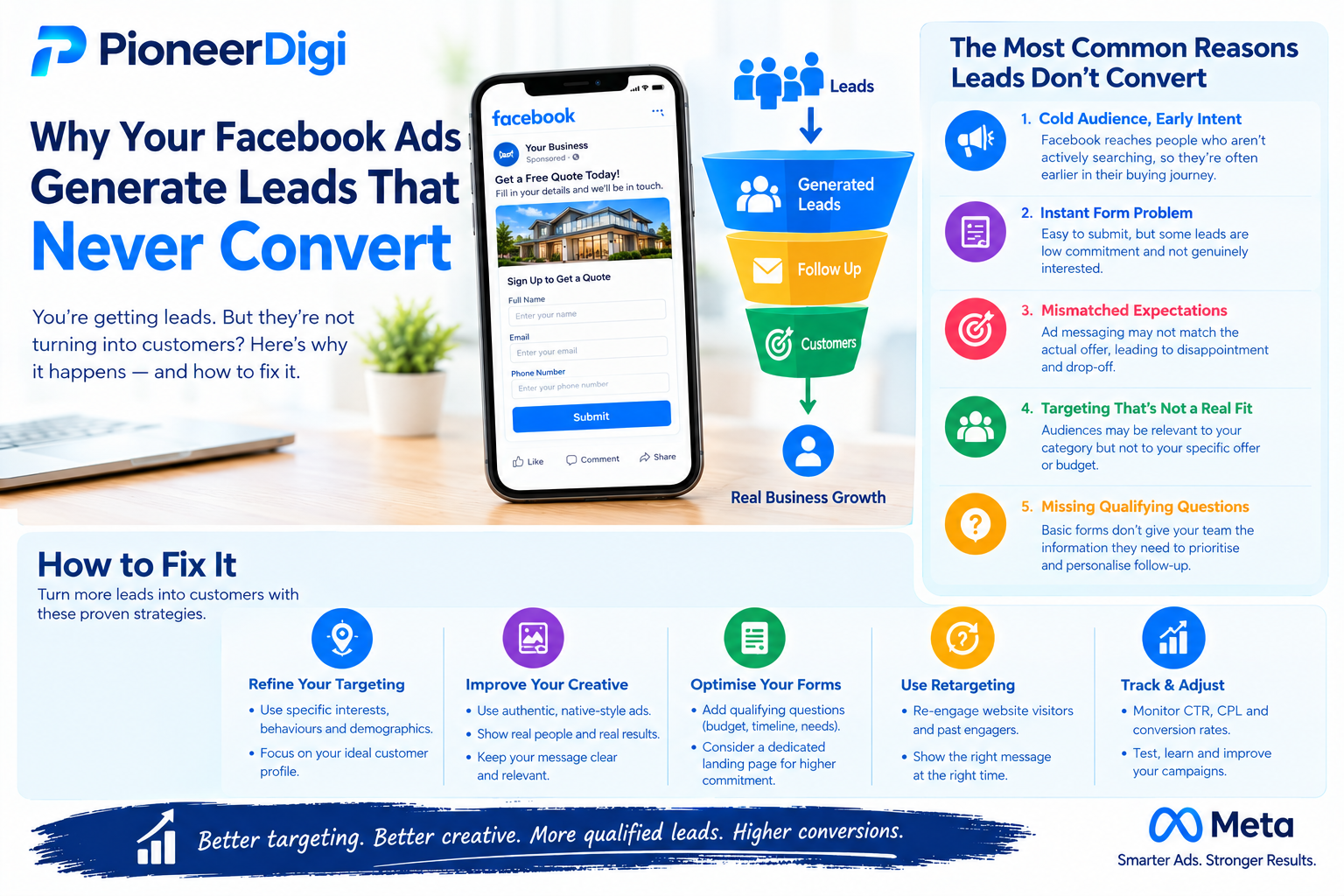
It's a particular kind of frustrating when a Facebook campaign is technically doing exactly what it was asked to do — generating leads at a reasonable cost, filling the pipeline with form submissions — and yet almost none of those leads turn into actual paying customers. The campaign looks successful by its own metrics while the sales team quietly stops bothering to follow up, convinced that "Facebook leads just don't convert."
This is one of the most common complaints about Facebook as a lead generation channel, and it's almost always explainable, rather than being an inherent flaw in the platform itself. This article works through the most common reasons Facebook leads fail to convert, and what to do about each one.
Start by Understanding Why This Happens More on Facebook Than Google
Before diagnosing specific causes, it's worth understanding the structural reason this problem shows up more frequently with Facebook leads than with Google Ads leads. Google Ads captures people in the middle of actively searching for a solution — they've already identified a need and are evaluating providers. Facebook interrupts people doing something else entirely, meaning the ad itself has to create interest in the moment, often before someone has fully thought through their actual need or timeline.
This fundamental difference means Facebook leads, on average, naturally arrive earlier in their decision journey than Google Ads leads, even when the campaign and offer are well executed. Some portion of the conversion gap between the two channels is simply this structural difference in average intent — not a flaw in the Facebook campaign itself, but a reality that needs to be managed through process rather than eliminated entirely.
The Instant Form Problem: Low Effort, Low Commitment
Facebook's native Lead Facebook Ads forms are specifically designed to minimise friction — pre-filled fields, a tap or two to submit, no need to leave the app. This ease is exactly what makes them effective at generating a high volume of leads at a low cost, but it also means some portion of submissions come from people who tapped through with relatively little genuine commitment, simply because doing so required almost no effort at all.
If a significant share of leads seem to go cold immediately, unresponsive to any follow-up attempt, this low-commitment dynamic is often at least part of the explanation. Testing a dedicated landing page instead of (or alongside) instant forms — requiring slightly more deliberate effort to complete — often produces a smaller volume of leads with a meaningfully higher average commitment level, worth weighing against the typically higher cost per lead that approach involves.
Mismatched Expectations Between the Ad and the Offer
If an ad's messaging creates an expectation that the actual sales process doesn't deliver on, leads can submit genuinely interested in what they thought was being offered, only to disengage once the reality becomes clear during follow-up. This might involve implied pricing that doesn't match reality, a service scope that differs from what's actually offered, or urgency language that oversells the actual timeline involved.
Reviewing ad copy honestly against the actual sales conversation that follows — checking for any gap between what's promised and what's delivered — often reveals specific messaging adjustments that would produce leads arriving with more accurate, aligned expectations, reducing the disconnect that causes early-stage drop-off.
Audience Targeting That's Technically Relevant but Practically Wrong
An audience can be demographically and behaviourally relevant to a business's general category while still being a poor match for the specific offer being advertised. Someone interested in home renovation content broadly might not be a genuine prospect for a premium, high-end renovation service if their actual budget and expectations sit at a different tier entirely — the interest is real, but the fit isn't.
Reviewing audience targeting specifically against the realistic profile of customers who actually convert — not just people who share a loosely related general interest — often reveals opportunities to narrow targeting toward genuinely better-fit prospects, even if this means accepting a smaller audience and potentially higher cost per lead in exchange for meaningfully stronger conversion rates further down the funnel.
Weak or Missing Qualifying Questions
A lead form that only collects basic contact information — name, email, phone number — provides no information to help a sales team prioritise or understand a lead before the first follow-up conversation. Without this context, every lead receives the same generic approach, regardless of how well or poorly they actually fit the business's ideal customer profile.
Adding a small number of genuinely useful qualifying questions — budget range, timeline, specific situation details — gives the sales team meaningful information to personalise follow-up and prioritise effort toward the most promising leads first, rather than treating every submission identically regardless of how clearly it represents a genuine fit.
Follow-Up That's Too Slow
Facebook leads, like leads from any channel, are time-sensitive — interest generated by an ad tends to fade quickly, particularly given the relatively low-commitment nature of many Facebook submissions discussed earlier. A lead followed up within minutes has a meaningfully higher likelihood of engaging than one contacted hours or days later, by which point the original moment of interest has often passed entirely.
Reviewing actual follow-up speed — not assumed speed, but genuine data on how long leads typically wait before first contact — frequently reveals this as a significant, fixable factor in poor conversion rates, particularly for businesses where lead follow-up isn't a dedicated, immediate priority but instead competes with other operational demands.
Follow-Up That's Too Generic
Beyond speed, the actual content and approach of that follow-up matters significantly. A generic, obviously templated message or call script that doesn't reference anything specific about what the person actually enquired about can feel impersonal and easy to ignore, particularly for leads who submitted with relatively low initial commitment in the first place.
Using whatever qualifying information was captured at the point of lead submission to personalise that first follow-up — referencing the specific service, situation, or detail they provided — tends to produce meaningfully stronger engagement than a generic, one-size-fits-all approach applied identically to every lead regardless of what they actually indicated interest in.
Treating a Single Touchpoint as the Entire Opportunity
Because Facebook leads often arrive earlier in their decision journey than search-driven leads, expecting every lead to convert after a single follow-up attempt sets an unrealistic standard that doesn't match how these particular prospects actually move through a decision process. Some genuinely promising leads simply aren't ready to commit after one conversation, not because they were never a good fit, but because they need more time, information, or a few additional touchpoints before deciding.
Building a structured follow-up sequence — multiple touchpoints over a reasonable period, rather than a single attempt followed by giving up — recovers a meaningful percentage of leads who would otherwise be written off prematurely as non-converting, simply because the follow-up process didn't account for a naturally longer decision timeline for this particular audience.
Sales Team Bias Against "Facebook Leads"
A less obvious but genuinely common factor: once a sales team forms a belief that "Facebook leads don't convert," that belief can become somewhat self-fulfilling, with those specific leads receiving less enthusiastic, less persistent follow-up than leads from a channel perceived as higher quality. This isn't necessarily a conscious decision, but a natural human tendency to invest less effort where expectations are already low.
Reviewing whether Facebook leads are genuinely receiving the same quality, speed, and persistence of follow-up as leads from other channels — rather than assuming the channel itself is inherently the problem — sometimes reveals that process and attitude, not lead quality, explain a meaningful share of the conversion gap.
Checking for Genuinely Invalid or Low-Quality Traffic
In some cases, a portion of leads may represent accidental submissions, bot activity, or genuinely disengaged users who tapped through without any real interest at all. While Facebook has systems in place to filter much of this automatically, reviewing a sample of recent leads for obvious signs of invalid submissions — nonsensical contact details, clearly mismatched information, immediate unresponsiveness across every contact attempt — helps determine whether a portion of the conversion gap reflects a genuine traffic quality issue worth investigating further, rather than assuming every non-converting lead represents a missed opportunity through follow-up alone.
Measuring the Right Thing From the Start
Businesses that only track cost per lead, without connecting those leads through to actual downstream sales outcomes, often don't realise how significant the conversion gap actually is until it's pointed out directly. Building reporting that tracks leads all the way through to genuine consultations, quotes, and closed sales — not just the initial form submission — makes this entire problem visible and measurable, rather than remaining an anecdotal frustration the sales team mentions occasionally without clear, specific data behind it.
Final Thoughts
Facebook leads that don't convert are rarely a sign that the platform itself is fundamentally unsuited to lead generation. In most cases, the gap reflects a specific, identifiable mismatch somewhere between the ad's promise, the audience's actual fit, the lead form's commitment level, and the speed and quality of follow-up that happens afterward — all of which can be diagnosed and improved with focused attention.
Working through these possibilities systematically, rather than writing off the entire channel, usually reveals that the underlying traffic was more valuable than the conversion data initially suggested — it simply hadn't yet been given a follow-up process genuinely suited to how Facebook leads actually behave, compared to leads arriving through a fundamentally different channel like search.

 English
 French
 Deutsch
 Русский
 Greek