


How to Match Ceiling Lights With Modern, Traditional, Minimalist, and Contemporary Interior Styles
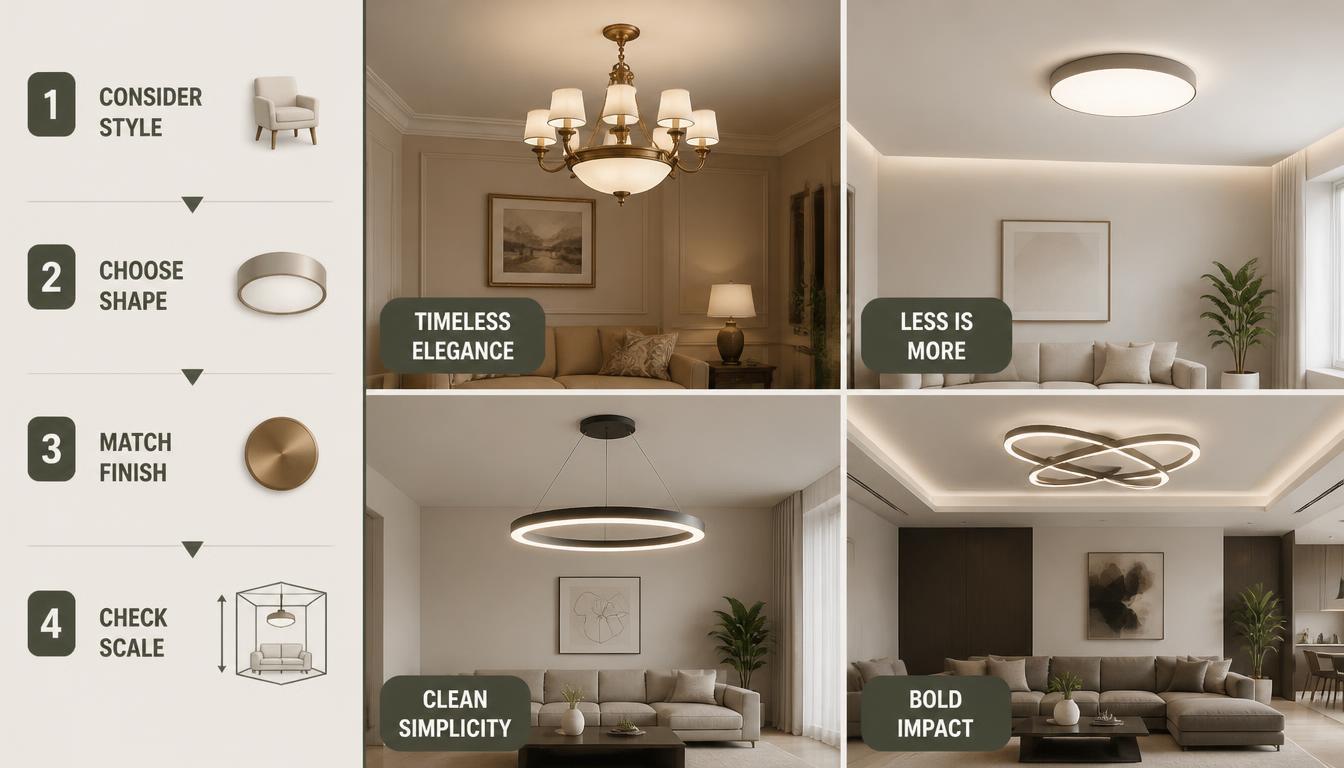
The ceiling lights must go well with the interior design of the house, but make sure that the lights do not become a distraction from the interior. All these attributes are taken into consideration while doing so.
Start With the Interior Design
In the first place, think about the interior design of the room. Once you have thought about that, pick lights that go with the interior design of the room.
|
Interior Style |
Fixture Direction |
Useful Finishes |
Light Character |
|
Modern |
Clean flush mounts, slim pendants |
Black, chrome, brushed metal |
Balanced |
|
Traditional |
Chandeliers, lanterns, detailed mounts |
Brass, bronze, warm metals |
Warm and layered |
|
Minimalist |
Recessed, compact flush, linear forms |
White, matte black, muted metal |
Quiet and controlled |
|
Contemporary |
Sculptural flush mounts, geometric pendants |
Mixed metals, glass, dark finishes |
Flexible and refined |
How Should Modern Rooms Use Ceiling Lights?
Modern spaces are effective with pure shapes and intentional light distribution. Select ceiling lights that create reiterating precision for the ceiling while remaining uncluttered.
You need to:
-
Pick simple cylindrical, disc-shaped, rectangular, or linear-shaped fixtures
-
Choose matte or bright materials to complement the existing sources of lighting
-
Make sure that you are getting dimmable equipment
-
Select fixtures equipped with diffusers
For open-plan rooms, coordinate fixture shapes across connected areas. However, matching each one is not necessary, but their visual mass must seem connected.
The DOE explains that LED fixtures can provide features like dimming, color adjustment, and optical control. These features suit flexible modern spaces.
What Works In Traditional Interiors?
Classic spaces require warmth and proportion. Lights should be integrated into the interior so that they do not appear to be decorative elements.
Chandeliers can be installed in the dining room and hallway. A lamp-like fixture could emphasize classic architecture in a great way.
Metal coupled with brass will complement the wooden furniture and the other main metal elements in your interior design. The lampshade will help to ensure that the soft lighting retains its elegance.
If you want to employ some furniture or classical architectural details in the design, it would be better to go for a symmetrical design. This will make it easy to give an impression of an appropriate size of the fixture.
How Can Minimalist Lighting Be Utilized?
Lighting fixtures made in minimalist style should be in harmony with the interior as well as provide the required illumination.
The lighting fixture will create less contrast with the design of the interior the closer it is to the ceiling. Contrast can be employed only when the lighting fixture has the intention to play a part as an accent piece.
Brightness should be measured in lumens, instead of watts. As explained by ENERGY STAR, while lumens are a measurement of the output of light, watts refer to electricity consumption.
In relation to color rendition, 3000K and 80+ CRI have been recommended by DOE for high-end lighting in homes.
The strategy allows for the design to utilize soft white light with excellent color rendering capacity.
How Are Modern Spaces Making Use Of Ceiling Lights?
Contemporary spaces incorporate ceiling lights as a lighting option. Geometry works very well in contemporary interiors.
Try the following for a better outcome:
-
Ring-shaped fixtures above open seating areas
-
Linear forms over long dining tables
-
Clustered pendants over kitchen islands
-
Sculptural mounts in entryways
Keep the fixture connected to another room element. Its finish might echo cabinet hardware, furniture legs, door handles, or nearby metal details.
This is where interior style coordination matters. The fixture does not need to match everything, but it should belong to the same visual conversation.
Selecting the Appropriate Light Quality for the Space
This is just one aspect of the selection process since the quality of the light itself has an impact on how the finishes, materials, artworks, and accessories appear.
Types of lights that have a warm or neutral quality have much to do with the comfort of many homes.
In kitchens, dining rooms, and any other room where a number of finish materials are used, one should consider the color choice.
Modern interior design often emphasizes harmony between fixture form, simplicity, and light quality.
Choose the Fixture by Room Scale
Scale can make suitable ceiling lights look wrong. When selecting one, it is important first to measure the space and consider some of the following:
-
Ceiling height
-
Arrangement of the furniture
-
Distance from the viewing point
-
Visual weight
In the case of dining areas, it is better to center the fixture above the dining table than just in the middle of the room.
For living rooms, the zones of sitting and sight lines must be taken into account. The brightest point should support the activity without creating glare.
A Practical Selection Sequence
Use this process when comparing ceiling lights for a finished room:
1. Identify the interior style.
2. Note dominant finishes and materials.
3. Choose the fixture shape.
4. Check the fixture scale.
5. Select suitable lumen output.
6. Compare CCT and color quality.
7. Confirm dimming and control compatibility.
8. Review glare and light distribution.
Circ Lighting applies this model to link the selection of the fixture with the overall design language of the room.
What Are The Common Matching Mistakes?
Do not choose a fixture from a different design style simply because it looks cool.
Other common problems include:
-
Using a decorative fixture where low-glare ambient light is needed
-
Choosing brightness by wattage alone
-
Ignoring ceiling height
Decorative lighting enhances the setting but still needs to serve a purpose and maintain the visual equilibrium of the area.
Final Takeaway
The ceiling lights, which are referred to as good-quality fittings, will be those that exactly fit the interior design, furniture, finish, and activity. This process begins with the design, and thereafter, one can make alterations in relation to the size, wattage, color, control, and finish. A good choice of lighting fixtures will give the right ambiance for different interior designs such as contemporary, traditional, and modern.

 Հայերեն
 French
 Deutsch
 Русский
 Greek