


Can You Increase Laundry Plant Capacity Without Moving to a Bigger Facility?
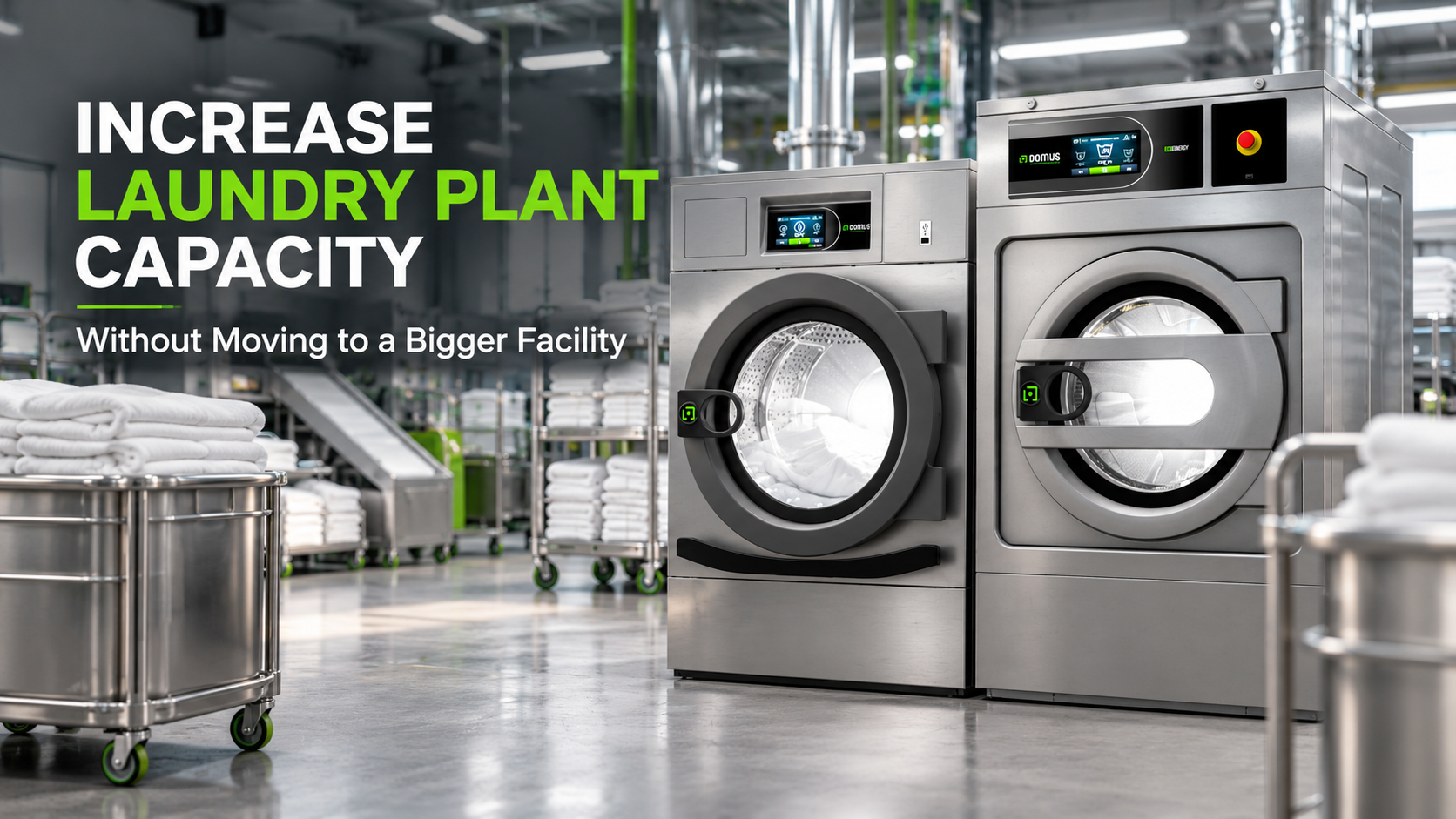
Your laundry is receiving more orders, but the machines and floor space haven't changed. Washing loads are waiting for dryers, finishing work is piling up, and dispatch deadlines are getting harder to meet.
Does this mean you need a bigger laundry facility?
Not always. Limited production capacity can result from inefficient workflows, unbalanced machinery, repeated handling, or equipment downtime rather than insufficient space alone.
Before investing in relocation, laundry owners should evaluate how effectively their existing industrial laundry equipment is being used.
Improving machine utilisation, reorganising production, and upgrading selected equipment may help increase daily output without moving to larger premises.
Why Does Laundry Plant Capacity Become a Problem as Orders Increase?
A laundry plant may operate efficiently at its original workload but struggle when daily orders increase.
More linen means additional washing cycles, drying time, finishing work, and quality checks.
When one stage takes longer than the others, laundry begins accumulating between processes.
For example, washers may complete their cycles on time while dryers remain occupied. Even though washing capacity is available, the facility cannot process additional loads efficiently.
This is why laundry plant capacity should be measured by completed, ready-to-dispatch laundry rather than the combined rated capacity of washing machines.
How to Identify Bottlenecks in Your Commercial Laundry Plant
A processing bottleneck occurs when one operation limits the output of the entire facility.
Most commercial laundries follow a similar workflow:
Sorting → Washing → Drying → Finishing → Quality Check → Dispatch
Start by identifying where laundry regularly waits.
Check whether washed linen accumulates near dryers, dried garments remain unfinished, or completed orders are delayed during inspection and packing.
Record processing times, machine idle periods, and daily output for several operating days.
If one stage consistently takes longer than the others, improving that operation may provide more value than purchasing additional machines elsewhere.
Understanding these delays is the first step towards better laundry production efficiency.
Can Better Industrial Laundry Equipment Increase Output Without More Space?
Replacing outdated machinery with a more suitable configuration may improve throughput within the same production area.
For example, a washer extractor with appropriate capacity, programmable controls, and improved extraction performance may help reduce processing delays.
Modern industrial laundry machines can also offer operating features that support more consistent cycle management.
However, larger equipment does not automatically mean greater productivity.
The machine must fit the available floor area while meeting electrical, water, drainage, ventilation, and maintenance-clearance requirements.
Before investing, compare the new machine's realistic daily output with that of the equipment being replaced.
The objective should be higher completed production, not simply greater installed capacity.
Are Your Washing and Drying Capacities Properly Balanced?
Washing and drying equipment must work together to maintain steady production.
Suppose a laundry has enough washing capacity to process 300 kg during a shift, but its dryers can handle only 220 kg under the same operating conditions.
The remaining washed laundry will wait for drying.
Adding another washing machine would not solve this problem.
Instead, the business should investigate dryer capacity, drying-cycle duration, residual moisture after extraction, and equipment utilisation.
A suitable commercial washer extractor can help remove excess water before drying, potentially reducing dryer workload.
Similarly, properly selected industrial tumble dryers can support consistent processing when drying capacity is the limiting factor.
How to Improve Laundry Production Efficiency Without Buying More Machines
Increasing output does not always require additional equipment.
Start with changes that improve the use of existing machinery.
-
Improve load scheduling: Prepare the next batch before the current cycle finishes.
-
Reduce unnecessary handling: Arrange collection baskets and trolleys closer to processing areas.
-
Control rewash: Identify repeated quality problems that consume additional machine time.
-
Train operators: Ensure staff understand loading, program selection, and garment handling.
-
Maintain machines: Clean filters and inspect equipment according to manufacturer recommendations.
-
Track daily production: Record kilograms processed, cycle duration, and delays.
Small operational improvements can help reduce idle time and keep laundry moving through the plant.
However, their effectiveness depends on the actual source of the capacity limitation.
Which Commercial Laundry Equipment Upgrades Should You Prioritise?
The right machinery upgrade depends on where production is being delayed.
|
Operational problem |
Equipment or improvement to evaluate |
|
Washing backlog |
Higher-capacity or additional washer extractor |
|
Excess moisture after washing |
Improved extraction performance |
|
Drying delays |
Commercial or industrial tumble dryer |
|
Finishing backlog |
Appropriate ironing or finishing equipment |
|
Frequent breakdowns |
Preventive maintenance or machine replacement |
|
Excessive chemical handling |
Suitable automatic dosing arrangements |
For example, if operators spend considerable time finishing flat linen, improving the ironing process may deliver more usable capacity than purchasing another washer.
Businesses evaluating upgrades can compare commercial and industrial washer extractors according to capacity, installation requirements, and processing needs.
The goal is to invest in the stage that actually limits daily output.
Can You Improve Laundry Plant Layout Without Expanding the Building?
Poor equipment placement can create unnecessary movement and handling.
Staff may repeatedly transport laundry across the facility because washing machines, dryers, sorting areas, and finishing equipment are poorly arranged.
A better layout can reduce these movements and improve production flow.
Consider placing compatible processes closer together, organising temporary storage, and providing clear routes for trolleys.
However, workflow improvements must preserve safe access, machine maintenance space, ventilation, and appropriate separation between clean and soiled laundry.
A well-organised facility can make existing machinery easier to operate without increasing floor area.
How to Calculate Your Laundry Plant's Actual Processing Capacity
Machine capacity is usually expressed in kilograms per load, but this does not directly represent daily plant output.
A basic calculation is:
Theoretical daily washing output = Rated machine capacity × Number of completed cycles
For example, a 30 kg washing machine completing eight fully loaded cycles has a theoretical washing output of:
30 × 8 = 240 kg per day
Actual production may be lower because of partial loads, fabric separation, cycle duration, loading time, or maintenance interruptions.
More importantly, this figure measures washing output rather than finished laundry.
If drying or finishing cannot process the same volume, the plant's completed output will be lower.
Measuring each processing stage provides a more realistic picture of available capacity.
When Should You Upgrade Equipment Instead of Moving to a Bigger Facility?
An equipment upgrade may be practical when the existing premises can safely accommodate machinery with better processing performance.
Before making the decision, compare machine replacement costs with relocation expenses, including new utility connections, building modifications, transport, and possible business disruption.
Relocation may become necessary when the facility lacks sufficient utility capacity, safe working space, or room for future operations.
However, when the main problem is an inefficient machine or isolated processing bottleneck, a targeted upgrade may be more economical.
Laundry owners should assess both options using their actual production requirements and long-term expansion plans.
How OrgaEarth Can Help You Select Industrial Laundry Equipment
Expanding laundry production requires selecting machinery that fits the existing workflow and available infrastructure.
Orgaearth Laundry Solutions supplies commercial and industrial laundry equipment for hotels, hospitals, laundromats, and professional laundry facilities.
Its product range includes washer extractors, tumble dryers, finishing systems, and supporting laundry solutions.
OrgaEarth can assist businesses with equipment capacity planning, machine selection, installation considerations, and technical guidance.
Laundry owners planning to increase output can explore OrgaEarth's industrial laundry equipment range to evaluate suitable options for their operating requirements.
Conclusion
Increasing laundry plant capacity does not always require moving to a bigger facility.
Production delays may result from unbalanced washing and drying capacity, inefficient handling, equipment downtime, or finishing bottlenecks.
Before relocating, measure actual daily output, identify the slowest processing stage, and review how effectively existing machinery is being used.
Targeted improvements and suitable industrial laundry equipment may help businesses process more laundry within their current premises.
The right expansion decision starts with understanding where production capacity is being lost.
Frequently Asked Questions
1. Can industrial laundry equipment increase production without additional floor space?
Yes, suitable machinery may improve processing capacity within existing premises. However, installation clearances, utility availability, and downstream equipment limitations must be considered.
2. How can I increase laundry plant capacity without buying new machines?
Improve load scheduling, reduce idle time, organise workflow, maintain machinery, train operators, and monitor rewash rates.
3. How do I calculate the daily capacity of an industrial laundry plant?
Calculate the output of each processing stage using actual load sizes and completed cycles. The plant's effective capacity depends on how much laundry can be washed, dried, finished, and dispatched.
4. Which commercial laundry equipment should I upgrade first?
Start with the operation creating the largest recurring backlog. This may involve washing, drying, finishing, or material handling.
5. Can a high-spin washer extractor improve laundry productivity?
Suitable high-spin extraction can reduce retained moisture, potentially shortening subsequent drying cycles. Actual benefits depend on fabrics, machine settings, and operating conditions.
6. When should a laundry business move to a bigger facility?
Relocation may be necessary when safe operating space, utility capacity, equipment access, or future production requirements cannot be accommodated within the existing building.

 English
 French
 Deutsch
 Русский
 Greek